
By: Stewards Individual Placement Corpsmember, Audrey Nell
My trip to Denali National Park and Preserve felt like a movie, something I couldn’t believe had happened and might not even believe now. I have always wanted to work for the National Park Service, but it was never something that I thought I would be able to do. It felt like a far-off dream that I had but did not know how to achieve. Like a mountain in the distance. Beginning my work as an outdoor recreation fellow at the Washington Support Office of the U.S. National Park Service was a step that I had been working and waiting for for a while. Around a week before my official start date, my boss and I hopped on a team call, and she informed me that the accessibility team, who I would soon be working with, would be traveling for a site assessment around a month later. She then asked if I wanted to go. My supervisor explained that this trip would be a great opportunity for me to meet the team I would be working with virtually and get some hands-on field experience. Of course, I said yes.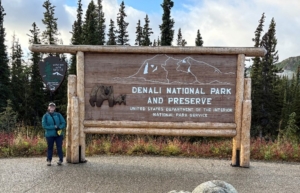
After a long travel day from DC to Anchorage and a four-hour drive, we made it to Denali National Park. The beautiful mountains loomed in the distance, getting closer with every mile. One of the things that I was most nervous about was meeting my co-workers, whom I would be spending a nearly unbroken week with. However, they proved to be just as kind and helpful as one could have hoped. This was my third week of work, and I still felt like I was in a new world.
After spending our first night in park housing, we set off on what would be our longest day. From the Denali Visitor Center and entrance to the furthest site assessment location was a four-hour drive one way. On our trip out, we were lucky enough to see caribou, brown bears, and so much beautiful scenery. Having a love of geomorphology, this proved to be the most time I had spent nerding out in a while. Glacial landscapes are distinct and perfectly tell the story through the land they scar as they move and melt.
When we finally got to Wonder Lake (the assessment site), we ate lunch with an amazing view and developed our plan for the day. There was a boardwalk that followed the lakeside and a campground that needed to be assessed. For the assessments, we used Survey123 to measure tread type, trail length, width, running slope, and cross slope, with the latter three being manually measured every 20 paces, a task that would prove to be time-consuming but rewarding.
Lots of outdoor recreation access is limited for those who use mobility devices. However, there is a lack of information that allows people to make that decision for themselves. Often, they are left to assume that there are no accessible routes, or they must go out and travel until they hit a barrier they cannot pass. Like those who do not use mobility devices, everyone’s physical ability and endurance differs. In addition, with the increasing number of action-track wheelchairs and devices like them, many are limited by the lack of information needed to make an informed decision about how they personally can navigate a trail, path, or campground.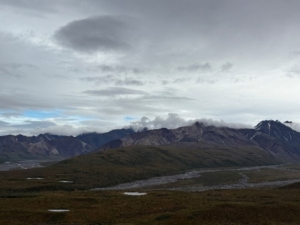
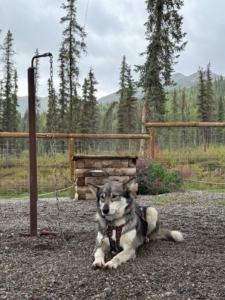
One of the most interesting parts of accessibility assessments is having to think about the park as a visitor. Especially in Alaska and at Denali, many people will only travel to the park once in their lifetime. So, we had to pay attention to one of the most visited sites in the park: the sled dog kennels. During the summer months, the kennels are open to the public, with demonstrations three times a day. Sled dogs are an essential part of winter operations in the park. They allow for swift, quiet, and simple travel across snow-covered areas, which minimizes disturbances to nature and limits noise pollution. Therefore, we had to assess the kennel and demonstration area as well. In addition, we spoke with the rangers who manage the site and learned about their accessibility procedures for the area. We also noted what we would recommend for the park to possibly reexamine. We also had the opportunity to feed the dogs dinner, which was incredible.
Overall, my trip to Denali National Park and Preserve proved to be an incredible learning opportunity about accessible recreation, allowing me to explain sites and understand the nuances of classifications. On paper, a lot of the elements of accessible outdoor recreation often feel like their implementation would be damaging to the natural world. However, this trip showed me that sometimes a fix to make a site usable can be as simple as adding fill to decrease the running slope or eliminate a lip in a board. This site visit proved to be extremely helpful in understanding the work I will be doing during my term at the National Park Service.